While deep reform is going on | Human Resources Department: Innovatively construct quantitative assessment method to solve the difficult problem of employee assessment in management department.
The Human Resources Department of CNNC thoroughly implemented the deployment requirements of the CPC Central Committee and the State Council on the reform of state-owned enterprises, continued to deepen the reform of three systems, focused on the difficulties and pains in the assessment of employees in management departments, and innovatively constructed a quantitative assessment method for employees in management departments based on standard working hours, thus realizing the quantification, visualization and comparability of the assessment results of employees in management departments. After the implementation of quantitative assessment, employees’ work initiative and enthusiasm have been greatly improved, and organizational transparency, trust and management fineness have been effectively improved, giving full play to the role of "one promotion and two growth" in promoting organizational performance and promoting the common growth of organizations and employees. The State-owned Assets Supervision and Administration Commission (SASAC) highly affirmed the quantitative assessment by "special publication publicity, special bonus points and special case selection", and promoted it within the scope of central enterprises.
First, create a "five jobs and one reform" system and create a new method of quantitative assessment.
The first is to innovate the new mode of R&D assessment. The quantitative assessment method is a performance management method which takes standard working hours as the unit of value, based on the systematic combing, work decomposition and working hours calibration of all the business of the management department, and carries out assessment, performance improvement and ability improvement accordingly. This method is objective and fair, and it can effectively solve the "five difficulties" problems, which are difficult to set the employee assessment indicators, difficult to quantify the performance standards, difficult to compare employees’ contributions, difficult to formulate improvement plans and difficult to widen the distribution gap. It is an original innovation different from traditional assessment methods such as KPI and 360-degree assessment.
The second is to summarize and refine the core elements. Under the guidance of PDCA method, the "five jobs and one change" organic framework of quantitative assessment work method is created, which includes work breakdown, working hours calibration, working hours acquisition, working hours verification, working hours application and performance improvement. The link of performance achievement and performance improvement is highlighted, and managers are required to strengthen support and guidance in the process of achieving employees’ performance goals, help employees achieve the set goals smoothly, and regularly analyze the attribution of working hours verification results, and formulate improvement measures at both organizational and employee levels to realize the closed loop of performance management and promote management improvement.
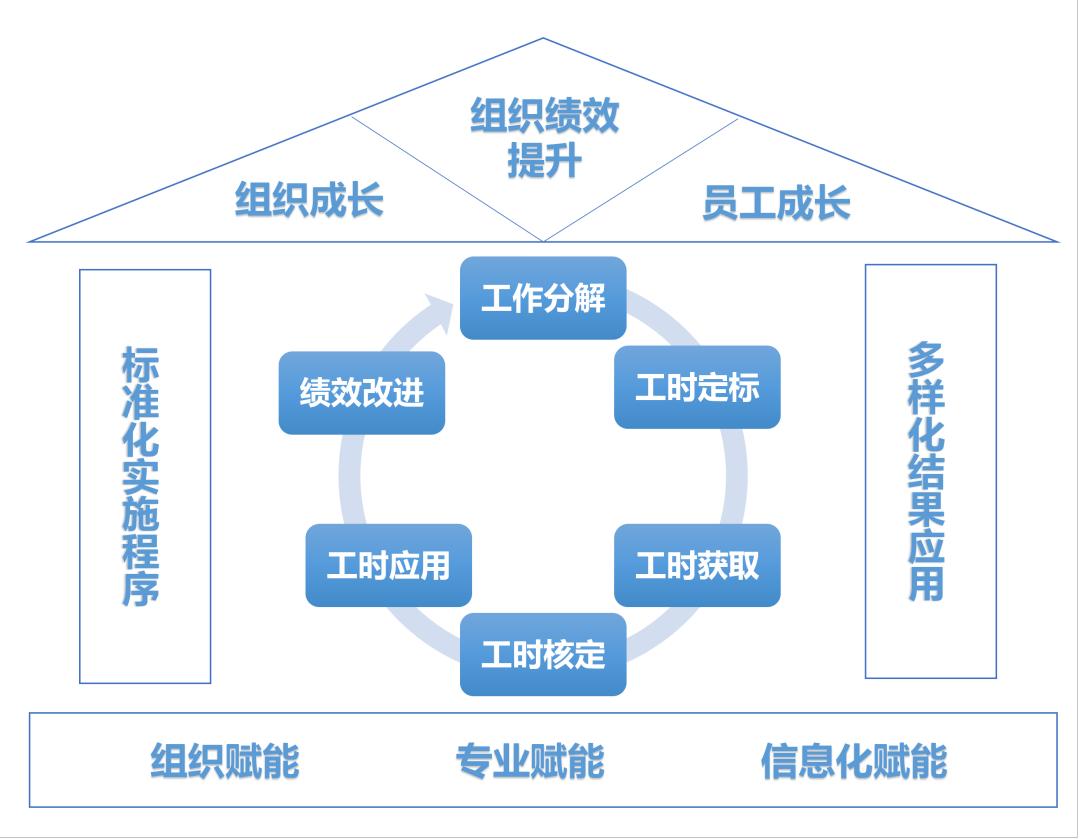
Connotation map of quantitative assessment system
The third is to scientifically design the standardized process. According to "pre-preparation-scheme formulation-scheme release-scheme implementation-evaluation and improvement", the standardized process and operation steps for the implementation of quantitative assessment work method are formulated. Focusing on the principle of gradual improvement and continuous improvement, the implementation of quantitative assessment is divided into two stages: introduction trial and formal operation. The introduction trial stage aims at getting through the whole process of quantitative assessment, and the approval of employee performance bonus is not linked to quantitative assessment results; In the formal operation stage, the quantitative assessment results will be released regularly and strongly linked to the bonus distribution, so as to give full play to the incentive function of quantitative assessment.
Second, establish a "three-tier empowerment" mechanism to promote the effective implementation of quantitative assessment.
The first is to strengthen "organizational empowerment". A three-level team of "leading group-development group-support group" was established, and a comprehensive management system of "decision guidance-professional support-resource guarantee" was formed. Formulate special work plans such as the Outline of Quantitative Assessment Work Plan, which provides overall guidance for the promotion of quantitative assessment work. Carry out the centralized office of the development team, discuss the problems in depth and provide professional solutions; Conduct training exchanges for many times to promote the joint improvement and promotion of all units. Strengthen positive incentives, select outstanding units to share their experiences at the CNNC Human Resources System Work Conference, and give special incentives and notices of praise to units with outstanding achievements.
The second is to strengthen "professional empowerment". Set up "one book and two databases" and compile "Guidance Manual of Quantitative Assessment Method for Employees in Management Department Based on Standard Working Hours", which provides a set of relatively systematic solutions, standardized program guidance and convenient tool support for quantitative assessment. The establishment of work breakdown database and standard man-hour database of various management departments has laid a solid foundation for accurately evaluating performance contribution and realizing performance-based payment, and summarized and formed a set of reproducible and popularized standard man-hour manual development methods. At present, standard man-hour manuals in six major management fields, including business management, financial management, human resource management, party building, discipline inspection and supervision, and comprehensive business, have been developed and compiled.
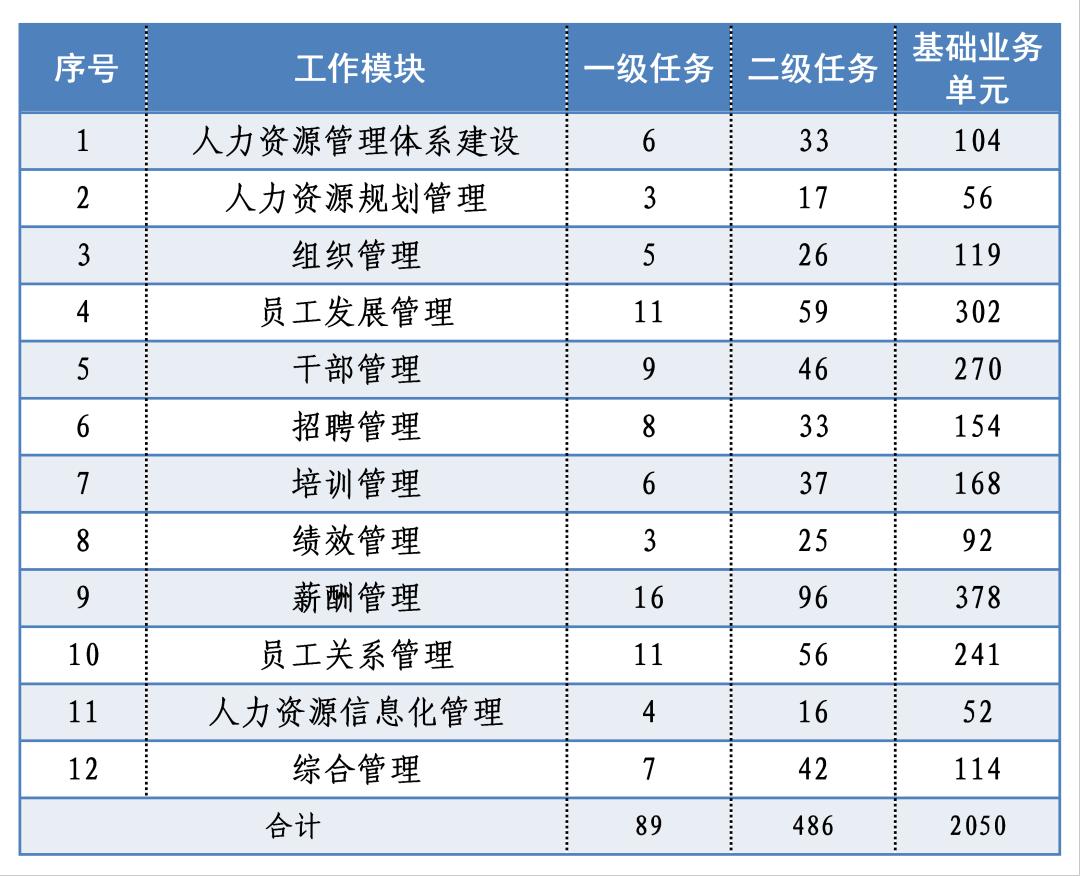
Human resource management work breakdown table
The third is to strengthen "information empowerment". The development of quantitative assessment information management system with the functions of standard man-hour database management, statistical man-hour management, assessment man-hour management and analysis report forms meets the needs of statistical analysis and application of quantitative assessment data of implementing units, effectively reduces the workload of quantitative assessment, improves the efficiency and quality of quantitative assessment work, and provides a useful exploration for data-driven human resource management.
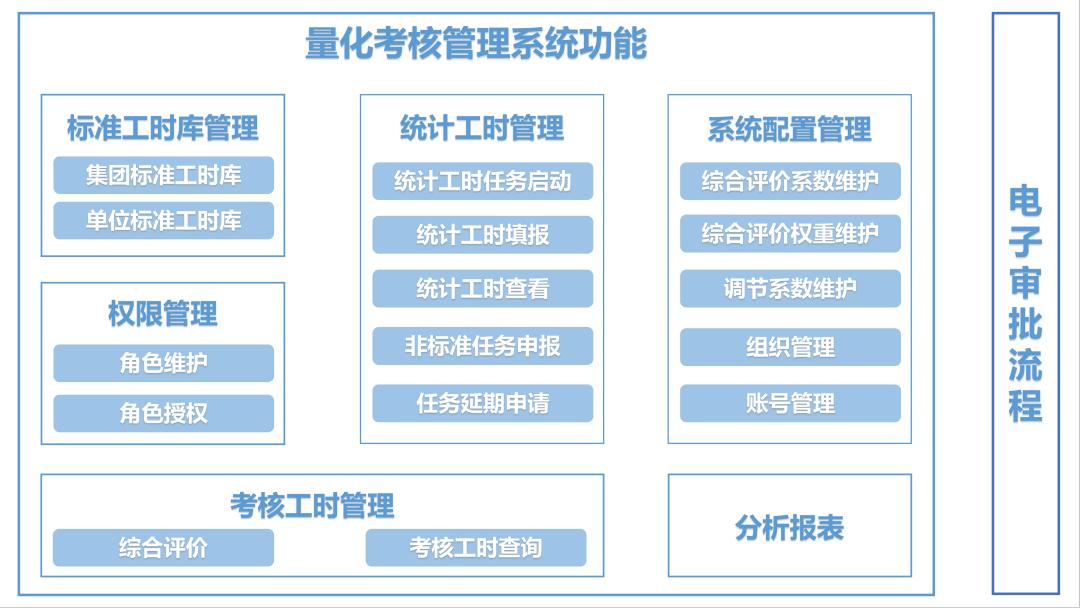
Overall architecture diagram of quantitative assessment information management system
Third, focus on the application of "three major aspects" and give play to the multi-dimensional value of quantitative assessment
First, focus on stimulating the vitality of employees. First of all, regularly publicize working hours data to motivate employees to change from "picking jobs" to "grabbing jobs". Publish the list of the top 30% employees in the total working hours assessment every month, create an atmosphere of catching up with learning, promote the employees with lower rankings to actively claim work tasks, and greatly reduce the difficulty of task allocation. Secondly, by improving the adjustment coefficient of strategic, innovative and difficult tasks, the enthusiasm of employees to apply for high-value tasks actively is improved, and the high-quality completion of various difficult and high-value tasks is promoted. Third, rigid cash assessment results, to achieve more work. By strengthening the linkage of assessment and distribution, the gap in bonus distribution can be effectively widened. After the implementation of quantitative assessment, the maximum increase of employee bonus is 26%, and the maximum decrease is 28%. The maximum difference of bonus distribution between employees in the same rank is over 60%.
The second is to focus on improving organizational effectiveness. First of all, through the implementation of quantitative assessment, the system of each unit is promoted to sort out the work, and the top-level design of the work is optimized, which improves the degree of systematization, business process, operation standardization and knowledge organization. Secondly, clear quantitative assessment data effectively enhance the transparency and trust of the organization, make employees more focused on the task itself, reduce complaints, reports, disunity and other behaviors, reduce internal friction of the organization and improve organizational cohesion. Thirdly, in-depth study and analysis of quantitative assessment results, expanding its application in the aspects of posts and personnel allocation, clear division of responsibilities, optimization of work plan and human resource allocation, cross-departmental performance measurement and comparison, providing reference for business decision-making, etc., and realizing the double improvement of management fineness and management efficiency.
The third is to focus on promoting the common growth of organizations and employees. First of all, as an effective carrier of excellent practice summary, the standard man-hour manual provides a reference for departments and employees in various management fields of CNNC to carry out benchmarking and identify the promotion direction, which can promote the business level and personnel ability and quality of the entire management line of CNNC. Secondly, the standard man-hour manual is a comprehensive and detailed "job description", which can help new employees or cross-post, cross-department and cross-unit exchange employees to quickly understand the work, improve work standardization and efficiency, and promote the cultivation of compound personnel. Thirdly, the quantitative assessment results are objective, fair and comparable, which provides a clear basis for managers to give performance feedback and help employees to make performance improvement plans, so that employees have a clear direction for performance improvement; Employees can also understand their own input-output ratio by analyzing the relationship between actual input working time and working hours, and improve their work effectiveness in a targeted manner.
Get honor:
SASAC published the article "China National Nuclear Corporation Innovatively Constructs Quantitative Assessment Method to Solve the Problems of Management Personnel Assessment" in the three-year reform action briefing, publicized the quantitative assessment within the scope of central enterprises, and gave CNNC special points as the highlight of the work.
The State-owned Assets Report rated the quantitative assessment as "innovative reform measures" in the exclusive report "The Power of Fusion" by China National Nuclear Corporation.
The theoretical journal China Human Resources and Social Security published a special article and made an exclusive interview with the quantitative assessment.
The practical case of quantitative assessment was selected in Comprehensive Typical and Special Typical Experience of Three-year Action of State-owned Enterprise Reform, won the first prize of management innovation of China National Nuclear Corporation and the annual "Innovative Case of Enterprise Human Resources Management" of China Human Resources Industry Association, and was invited to exchange experiences in the National Defense Industry Enterprise Association and China Human Resources Development Research Association, which aroused positive response.
Recommended reading
▼
(Click on the picture to read the full text)
Original title: | Human Resources Department: Innovating and Constructing Quantitative Assessment Method to Solve the Problem of Staff Assessment in Management Department.
Read the original text